

Role of GVCS and Ruma Devi Foundation
The journey of Vani Utsav could not have reached this level without the support of Gramin Vikas Evam Chetna Sansthan (GVCS) and the Ruma Devi Foundation.
GVCS has been the organisational backbone, mobilising communities, documenting traditions, and providing the structure for grassroots-level events. Their long-standing work in cultural preservation and rural empowerment naturally extended into reviving Saint Vanis.
The Ruma Devi Foundation brought a new dimension by connecting Vani Utsav with larger cultural and social platforms. Through Ruma Devi’s leadership and vision, the festival has gained recognition across states, ensuring that women artisans, folk singers, and local communities find space and voice in this movement.
Together, GVCS and RDF ensure that Vani Utsav is not just an event, but a sustainable cultural revival with social impact.



The Story of Vani Utsav
Vani Utsav is not just a event; it is a living movement to preserve humanity’s spiritual legacy, revive forgotten traditions, and pass them to future generations.
Vani Utsav
It is a heartfelt movement to preserve the spiritual heritage of Saint Vanis, revive the sound of the Veena, and bring back the tradition of satsangs that once united communities across India. Born from the vision of dedicated individuals like Vikram Singh, this movement began humbly in the late 1990s with a few cassette recorders and a dream to ensure that the timeless words of saints are not lost to silence.
Today, Vani Utsav has grown into a living tradition where hundreds of artists, from seasoned Vina players to emerging voices, come together to celebrate devotion, humanity, and the art of inner awakening. It is not just about music, it is about keeping alive the essence of Humanity.
The Meaning of Vani
Vani Utsav means the Festival of Vani. Here, Vani refers to the words of saints, spiritual verses born from deep personal experiences. For centuries, these Vanis have guided society, offering wisdom, awakening, and discipline.
Unlike today’s popular music, rooted in entertainment, Saint Vanis embody devotion, meditation, and spiritual truth. They range from Guru Vanis(गुरु की महिमा) and words of caution(चेतावनी की वाणी) to verses on yoga(योग की वाणी), samadhi(समाधि की वाणी), Sagun worship(सगुण भक्ति), and Nirgun devotion(निर्गुण उपासना).
Prominent followers of Nirguna worship included Kabir Das, Gorakh Nath, Guru Nanak, and Dadu Dayal. Saints like Tulsidas, Surdas, Mirabai, and Nimbarka were the main pioneers of Saguna Bhakti.


A Tradition Over a Thousand Years Old
The tradition of Vanis is more than a millennium old. From the Bhakti era saints, such as Kabir, Dadu, and Meera, to the much earlier Gorakhnath Ji and Saharapa (7th–10th centuries), Vanis have been integral to India’s spiritual heritage.
These verses cut through hypocrisy and division, uniting society in the values of humanity, equality, and devotion.
Satsangs and awakenings were once the lifeblood of villages, rich and poor, upper and lower castes all sat together, sang, listened, and discussed. This communal tradition became a tool of unity during times when untouchability and social discrimination were widespread.
The Role of the Veena
In earlier times, Vani singing was performed on the Veena - the sacred instrument of knowledge. Its simple strings resonated with the divine Naad, a sound resembling what is heard in meditation.
Over time, with the rise of cities and the advent of modern music, these traditions began to fade. Bollywood and Western culture took centre stage, and the discipline of satsang singing weakened.


How Vani Utsav Began
Amidst this decline, the Vani Utsav movement began in 1996–97, when young college students and local enthusiasts started recording saint Vanis in villages.
Using pocket money to buy second-hand cassette recorders and a determination to preserve what was vanishing. This marked the humble but passionate origin of Vani Utsav.
The movement originally started with Vikram Singh, Secretary of the GVCS and a believer in the power of these traditions. He faces struggles in every step; the cost of technology at that time was high and was not easily available.
The villages were remote with zero road connectivity. They had to walk miles just to reach satsang. Many artists viewed him as a commercial studio employee, and many refused to be recorded, fearing being used. What began as a small effort of preservation soon turned into a vision for revival.
The Inspiration of Dan Singh Ji
The movement found its true strength through Dan Singh Ji, a legendary Veena artist. Known as the Koel of Marwar, his mesmerising voice carried for miles even without loudspeakers.
He naturally joined Vani Utsav, where he performed and mentored until his last days. On the day of his death, he recorded the bhajans that very evening. This was Dan Ji's dedication towards Vani Utsav.
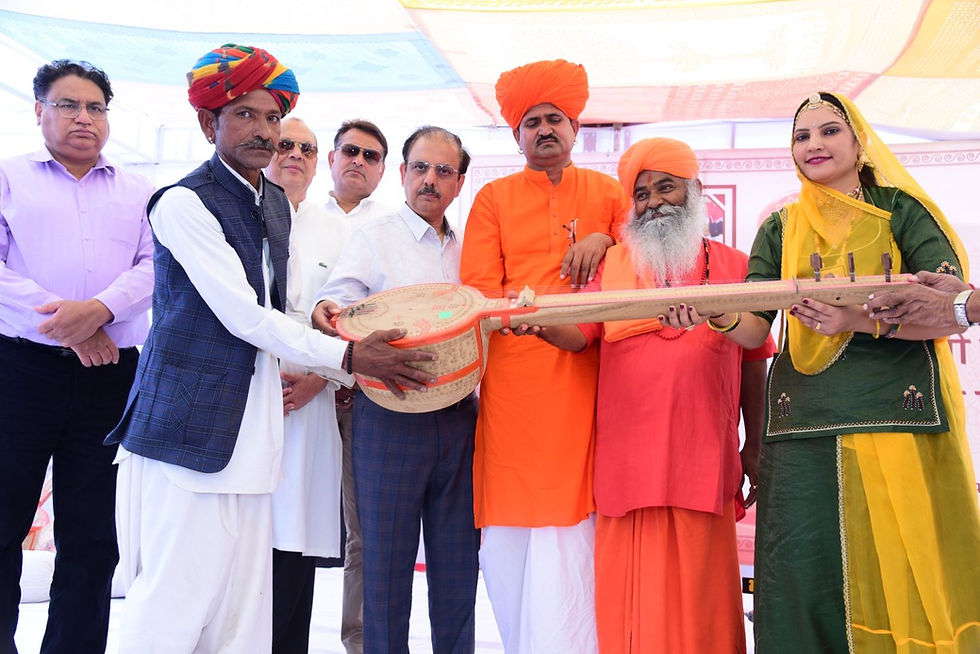
In his memory, the "Dan Ji Smriti Marwar Bhajani Award" was instituted, honouring artists with recognition, financial support, and Veenas.
He was a close friend of Mobata Ram, who dedicated his life to Bhajans. Mobata Ram was the father-in-law of Dr Ruma Devi.
Since Vikram Singh was taking Vani Utsav forward with Daanji, Ruma Devi's and Vikram Singh's path naturally moved forward with this initiative.


Growing Into a Festival
From small gatherings, Vani Utsav grew into public celebrations, supported by local administration and cultural institutions. In 2008, Ruma Devi joined the Vani Utsav Movement, and it subsequently progressed with greater stability and consistency.
By 2013, it had achieved a breakthrough when Ruma Devi requested that Chief Minister Vasundhara Raje allocate a stage for Bhajans during Rajasthan Day.
Today, the annual Vani Utsav runs as a 36-hour festival, featuring 500–1000 artists from multiple states, honouring them with awards and supporting Veena craftsmen to keep the tradition alive.
We are continuing our tradition of singing and recording regular bhajans at the premises of GVCS and Ruma Devi Foundation. Everyone is invited to join us as we delve deep into the world of Vani.
Impact and Vision
Vani Utsav has restored dignity to Veena artists once considered irrelevant. Today, they are celebrated, respected, and sought after by new generations eager to learn.
Our mission is to preserve, nurture, and revive these timeless traditions so they remain alive for centuries to come.
The vision of Vani Utsav is to build a society where humanity comes first—above caste, gender, wealth, or status. It seeks to reconnect individuals with their inner power, echoing the Indian belief that “what is in the universe is in the body, and what is in the body is in the universe.”

The Road Ahead
In the next decade, Vani Utsav aspires to inspire more artists to create their own identity in Vani singing, spreading the mission organically rather than through centralisation.
The aim is not just to increase the number of performers and listeners, but to see Vani traditions multiplied in homes, villages, and communities everywhere.
What Makes Vani Utsav Unique
Unlike other cultural journeys, Vani Utsav is not a project or performance-driven initiative. It is a grassroots movement committed to authenticity.
We do not dilute Saint Vanis with fusion or commercialisation. Just as sacred texts cannot be altered, the words of saints must remain pure.
Vani Utsav stands as a guardian of this heritage, ensuring that devotion is never compromised for entertainment.
